What Is Real-Time Data Governance?
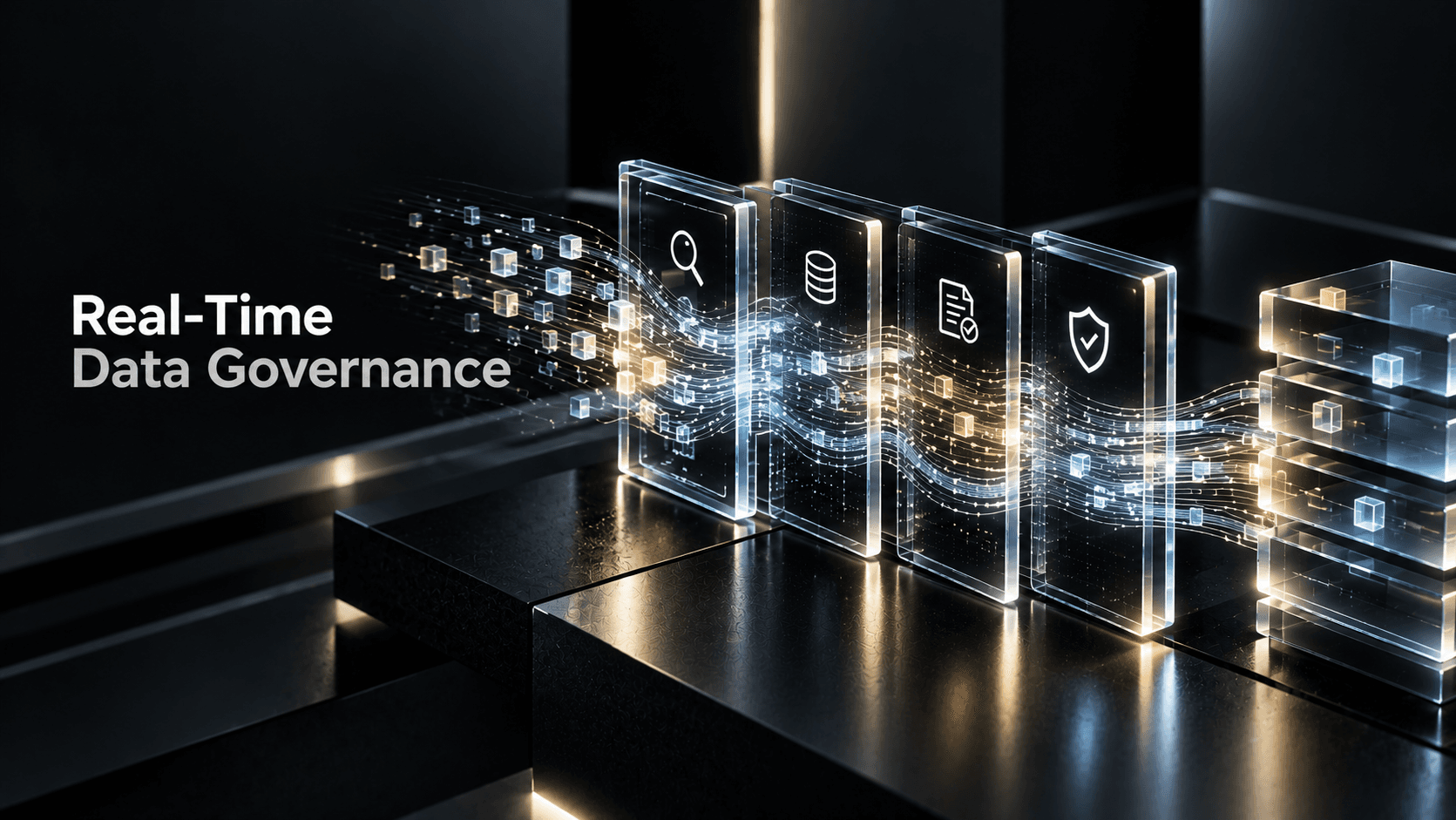
An organisation might discover, during a quarterly review, that permissions had quietly become excessive, that a sensitive dataset had been copied somewhere new, that an external service had gained access it shouldn't have, that a retention deadline had already passed, that a new dataset had appeared without anyone registering it, or that an AI system had begun using customer information.
- Permissions had quietly become excessive.
- A sensitive dataset had been copied somewhere new.
- An external service had gained access it shouldn't have.
- A retention deadline had already passed.
- A new dataset had appeared without anyone registering it.
- An AI system had begun using customer information.
In each case, the governance controls may have been correct on paper. The organisation simply learned about the event too late to do much about it.
What changes when governance moves closer to the moment data is actually being used?
What is real-time data governance?
“Real-time data governance” is best understood as an architectural direction rather than a single standardised technology category. It describes an approach in which data visibility, policy evaluation and control move closer to the moment data is created, accessed, changed, shared or moved — not a requirement that every governance process happen instantaneously, and not a replacement for the wider data governance an organisation already does.
Some governance activity will remain periodic, manual or asynchronous, and reasonably so:
- Traditional / periodic governance
- Review, document, reconcile, audit, remediate later. Structured, dependable, and well suited to work that doesn't need an immediate answer.
- Event-aware / near-real-time governance
- Observe, understand, evaluate, decide, act, audit. Suited to activity where the cost of finding out late is genuinely high.
These aren't mutually exclusive categories, and a mature governance programme can reasonably require both. The objective isn't to make every governance activity instantaneous — it's to reduce the gap between what is happening to data and the organisation knowing and responding to it. That distinction is the subject of the rest of this piece.
The governance gap
It helps to have a simple model for that gap. When something happens to data, there's a delay before the organisation knows about it, a further delay before it can evaluate what policy says about it, and a further delay before it can actually do something in response:
This is a useful way to think about the problem — not an established industry-standard term. Examples worth running through it: a sensitive dataset copied to a new system, an employee receiving privileged access, an AI application starting to retrieve customer records, a retention deadline passing, an external integration beginning to receive regulated information. In each case, the shorter the governance gap, the sooner the organisation can understand what happened and respond to it.
What needs to become more dynamic?
Closing that gap touches most of the capability areas governance already depends on:
- 01DISCOVERY
- Detect new data assets and locations.
- 02CLASSIFICATION
- Understand when new or changed data becomes sensitive.
- 03ACCESS
- See changes in who and what can use data.
- 04POLICY
- Evaluate applicable rules as context changes.
- 05MOVEMENT
- Understand where data is being copied or sent.
- 06RETENTION
- Identify when data reaches governance milestones.
- 07MONITORING
- Observe important activity.
- 08CONTROL
- Restrict, revoke, quarantine, approve or otherwise respond, where supported.
- 09AUDIT
- Record the event, decision and response.
It's worth being technically cautious here: not every underlying system offers the same telemetry, and not every system offers the same enforcement capability. Discovery and monitoring might be near-continuous for one data source and only periodic for another, depending entirely on what that system actually exposes.
Real-time doesn't mean everything is instant
This is worth stating plainly, because the phrase invites the wrong reading. Different governance activities reasonably operate at different speeds:
- Immediate / event-driven
- Potentially appropriate for high-risk access or policy events, where evaluating before an action completes materially changes the outcome.
- Near real time
- Seconds to minutes, depending on the systems and integrations involved — useful for most monitoring and alerting.
- Periodic
- Useful for reviews, certification, quality checks and governance processes that genuinely don't require immediate action.
- Manual / human review
- Required for decisions that need judgement or formal approval, regardless of how quickly the underlying event was detected.
The correct governance latency depends on the risk and the decision, not on a blanket preference for speed. That's a stronger and more honest position than simply arguing everything should happen in real time.
From static catalogue to live data understanding
Traditional data catalogues are genuinely useful — and can become stale if the underlying environment changes faster than the metadata describing it gets refreshed. That's not an argument against catalogues; it's an argument for treating them as one point on a progression rather than the end of the work:
Active governance doesn't replace the catalogue. It's what keeps the picture the catalogue describes closer to what's actually true.
Real-time data access governance
Data access governance is one of the clearest places this matters. Access changes constantly and for ordinary reasons: an employee changes role, a contractor's engagement ends, a service credential is rotated, an application gains a new permission, an AI system receives access to sensitive data, a dormant account suddenly becomes active again.
Rather than learning weeks later — at the next access review — that an application received sensitive-data access, more current visibility can let an organisation detect the change much sooner and evaluate whether it's actually appropriate. That's a meaningful improvement over periodic review alone. It's not a promise of universal prevention — some access changes will still only surface on review, depending on what the underlying system actually reports.
Data movement
Data gets read, copied, transformed, exported, shared, replicated, sent externally, or used as context for an AI system. A governance system that only understands where data is stored is missing half the picture; it increasingly needs to understand where data is going:
Actors here span the same range access governance already has to account for — a person, an application, a service, an API, an AI system, an agent. AI is one entry on that list, not the reason the list exists; the underlying question — what moved, and under what authority — is the same one regardless of which kind of actor is asking.
Policy at the moment of use
A traditional policy might read:
“Customer personal data must not be shared with unauthorised external services.”
Operational governance asks a more specific version of that question at the moment an action actually happens: what data, who or what is asking, what action is being requested, what destination, which policy applies, and — from that — what decision follows.
Policy becomes substantially more useful when it can influence behaviour in the moment, not only describe expected behaviour after the fact. Not every enterprise system supports pre-action enforcement today — this is architectural framing for what a decision point needs to be capable of, not a claim that every integration Sentinel connects to can act on it.
Pre-action vs post-action governance
- Pre-action
- Evaluate before an action occurs. Useful wherever the integration and control point actually support intervening in time.
- Post-action
- Detect, log and respond after an event has already happened. Still valuable where pre-action enforcement is impossible, impractical or undesirable.
Take an application attempting to export sensitive customer information. Pre-action governance would evaluate the request and potentially deny, approve or restrict it before the export completes. Post-action governance would detect the export after the fact, generate an audit event, alert the right people, and potentially revoke access or trigger remediation. A realistic enterprise architecture tends to use both — pre-action where it's available, post-action everywhere else.
Human approval still matters
None of this is an argument that automation is universally preferable. Some decisions should stay human-controlled regardless of how quickly they could technically be evaluated — mass deletion, high-impact access revocation, regulatory exceptions, legal holds, unusual data exports, ambiguous policy conflicts. The pattern for those looks less like automatic enforcement and more like a governed approval step:
This is the model a future governed-action capability in Sentinel would need to follow — faster detection feeding a decision, not faster detection replacing the decision-maker.
AI makes governance latency more important
AI systems can operate at machine speed. They may retrieve data, combine datasets, call tools, generate outputs, move information and take actions considerably faster than the review cycles most governance programmes were built around. Quarterly visibility into what an AI system is doing with enterprise data may simply be too slow for certain high-risk workflows — not because AI is uniquely dangerous, but because the gap between an event and an organisation noticing it matters more when the actor generating events can generate a lot of them quickly.
We cover the agent-specific side of governance in AI agent security and enterprise AI governance. The point here is narrower: as the speed of data use increases, governance may need to become more responsive to keep pace with it. Data is still the subject.
A reference architecture for real-time data governance
Put together, the pieces above describe a conceptual layering — not a claim that one product needs to own every layer:
What information does dynamic governance need?
For a given event, a useful record needs real structure behind it — illustrative, not an industry standard:
| FIELD | WHAT IT CAPTURES |
|---|---|
| Data asset | What the event relates to. |
| Classification | How sensitive it is. |
| Owner | Who is accountable for it. |
| Current location | Where it is now. |
| Source | Where it originated. |
| Actor | Who or what is involved. |
| Actor type | Person, service account, application, AI system or agent. |
| Identity | How the actor authenticates. |
| Requested action | What's being requested or was performed. |
| Destination | Where the data is going, if applicable. |
| Access level | What the actor is permitted to do. |
| Applicable policy | Which policy governs the event. |
| Risk context | What makes this event higher or lower risk. |
| Approval requirement | Whether approval is needed, and from whom. |
| Event time | When it happened. |
| Decision | What was decided. |
| Control action | What was done as a result, if anything. |
| Outcome | What actually happened next. |
| Audit reference | Where the full record lives. |
A practical checklist
- Discover important data sources.
- Identify sensitive datasets.
- Assign ownership.
- Map human and machine access.
- Understand data movement.
- Identify events that require faster governance.
- Define acceptable governance latency by risk.
- Establish policy.
- Identify available enforcement points.
- Define approval requirements.
- Monitor access changes.
- Monitor external destinations.
- Record decisions.
- Maintain auditability.
- Define remediation.
- Review controls periodically.
- Don't automate decisions that require human judgement.
Where Sentinel fits
Reducing the gap between data activity, understanding and control is central to the problem Porthos Labs is exploring with Sentinel. Sentinel is being designed around a data-first model: helping organisations discover and understand enterprise data, see who and what can access it, understand the policy that applies, and move from visibility toward governed action.
The longer-term direction is to make questions like these easier to ask, and appropriate controls easier to execute through authorised, auditable workflows:
- Who can access payroll data?
- Which systems are using customer information?
- Where has this dataset been copied?
- Which sensitive data is being sent externally?
- Which access should be reviewed?
Not every capability described in this piece is available today. This is a direction Sentinel is being built toward, not a claim about its current feature set.
Closing
Governance is most useful when it reflects what is happening to data now, not only what was true when the last review was completed. Not every decision needs to happen instantly. But as enterprise data environments become more dynamic, the distance between activity, understanding and control matters.
See sooner. Understand faster. Control when it matters.