What Is Enterprise AI Governance?
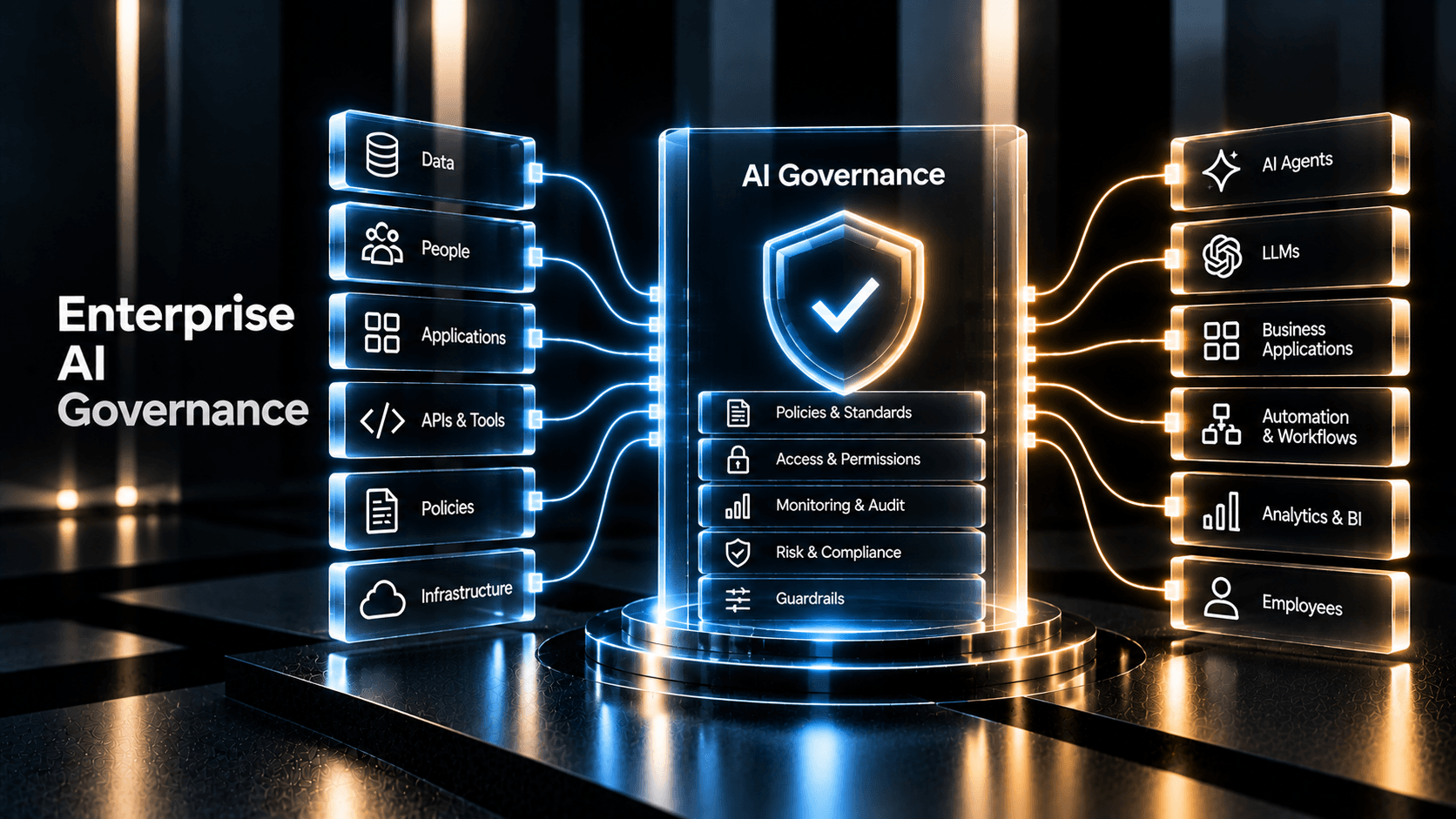
AI governance becomes necessary the moment AI moves from isolated experimentation into normal business operations. One team piloting a model is a project. Dozens of teams adopting models, assistants and autonomous agents at once is something else — and it needs a consistent way to determine what may be used, by whom, for what purpose, with what level of authority, and under what controls.
The challenge is not simply creating more AI policy.
It is turning policy into a system that can actually guide and control how AI operates across an enterprise.
What is enterprise AI governance?
Enterprise AI governance is the system of accountability, policies, controls and oversight an organisation uses to decide how AI systems may be developed, deployed and operated. In practice, governance is what answers a specific set of questions for every AI system in use:
- Which AI systems are allowed?
- Who owns them?
- What data may they use?
- What actions may they take?
- What level of autonomy is appropriate?
- What controls are required?
- How are decisions recorded?
- Who is accountable when something goes wrong?
Answering those questions well spans a wide set of activities:
- Ownership
- Accountability
- Acceptable use
- Data access
- Model/provider approval
- Risk classification
- Permissions
- Testing
- Human oversight
- Monitoring
- Auditability
- Incident response
- Lifecycle review
Governance is broader than compliance. Compliance asks whether a system satisfies a specific external requirement. Governance asks the more fundamental question underneath that: does the organisation actually know what it's running, who's responsible for it, and what it's allowed to do — regardless of whether any particular regulation applies yet.
Why AI governance is different from traditional IT governance
Existing IT and data governance foundations still matter — ownership, access control and change management don't stop applying just because a system happens to involve AI. But AI introduces characteristics that traditional IT governance wasn't built around:
- Probabilistic outputs, rather than deterministic ones
- Model behaviour that shifts with context and input
- Natural-language interfaces, which are far easier to misuse than a form with fixed fields
- Decision paths that are often opaque even to the people who deployed the system
- Rapid third-party model adoption, often faster than procurement can review it
- Autonomous or semi-autonomous execution
- Agents that call tools on their own initiative
- Broad access to enterprise knowledge by design
- Emergent behaviour that wasn't explicitly programmed
- Dependency on a model provider's own decisions, updates and security posture
None of this makes existing governance obsolete. It means AI adds new questions on top of the ones organisations already know how to ask.
Governance begins with visibility
An organisation cannot govern AI systems it does not know exist. This is the same starting point covered in our piece on shadow AI, and it applies just as directly here: governance has nothing to act on without an inventory of:
- Models
- AI applications
- Agents
- Providers
- Owners
- Business purposes
- Data connections
- Tools
- Permissions
- Environments
- Risk classifications
- Approval status
Clear ownership and accountability
Every meaningful AI system should have an identifiable owner — not a department, a named person or team who can answer for it. Depending on the system, that responsibility is often split across a few roles:
- Business owner
- Accountable for why the system exists and whether it's still serving its purpose.
- Technical owner
- Accountable for how it's built, deployed and maintained.
- Data owner
- Accountable for what data it touches and how.
- Risk/governance owner
- Accountable for its risk classification and ongoing compliance with policy.
There's no single universal operating model that fits every organisation — a five-person startup and a regulated bank will split these roles differently. What matters is that the split is explicit. Accountability should be established before deployment, not reconstructed after an incident.
Risk classification
Not every AI system needs the same controls. A practical governance model tiers systems by risk rather than applying one standard uniformly. The following is an illustrative enterprise framework, not a regulatory standard:
LOWER RISK
- Drafting internal text
- Summarising non-sensitive documents
- Low-impact productivity assistance
MODERATE RISK
- Accessing internal operational data
- Making recommendations
- Interacting with enterprise workflows
HIGHER RISK
- Modifying records
- Making external communications
- Handling sensitive data
- Approving transactions
- Changing infrastructure
- Acting autonomously across multiple systems
Policy needs to become enforceable
This is where governance most often breaks down in practice: the gap between written policy and enforceable control. A policy document can state something like:
“AI systems must not send sensitive customer data to unapproved external services.”
That sentence is easy to write and hard to operationalise. An operational governance system needs to be able to connect that rule to concrete signals:
- System identity
- Data classification
- Destination
- Permissions
- Action context
- Approval requirements
and, from those signals, actually determine whether a given action should:
- Proceed
- Be denied
- Require approval
- Be logged for review
This is an architectural description of what that connection needs to look like — not a claim that Sentinel, or any product, currently performs all of it in customer production today. It's also, broadly, the problem an AI control plane is trying to solve architecturally.
AI governance and AI security
Governance and security are frequently discussed as if they're the same thing, covered in more depth in our piece on AI agent security. In short:
- Governance defines
- Accountability, policy, risk appetite, oversight and approval.
- Security provides
- Identity controls, access controls, execution controls, monitoring, containment and protection.
Governance without security can remain theoretical — a well-written policy with nothing enforcing it. Security without governance can lack organisational intent — strong controls with no clear rule for what they're actually supposed to allow or stop. They need to work together.
Governance becomes more important with autonomous agents
Governance gets more operational, not just more important, once systems can act rather than only respond. That shifts the questions toward:
- Delegated authority — what an agent is acting on behalf of, and with whose permission
- Tool permissions
- Data permissions
- Autonomous decision boundaries
- Approval thresholds
- Inter-agent communication
- Escalation — what happens when an agent hits something it shouldn't decide alone
- Revocation — how access gets pulled quickly
- Containment — how an agent gets stopped
Organisations need to govern not only what AI can generate, but what it can execute.
Human oversight should be proportional to impact
Not every AI action should require approval. Not every AI action should be fully autonomous. A risk-based model scales the approval requirement with the actual impact of the action:
LOW IMPACT
- Summarise internal meeting notes
MEDIUM IMPACT
- Update a low-risk internal workflow
HIGH IMPACT
- Delete production data
- Send sensitive information externally
- Approve a payment
- Change access permissions
- Deploy code
As impact rises, so should the bar for approval — moving from no review, to logged review, to a required human sign-off before the action happens at all.
The enterprise AI governance lifecycle
Put together, a workable governance process tends to follow a consistent progression:
What should an AI governance record contain?
For each system in the inventory, a useful governance record needs enough structure to actually drive decisions:
| FIELD | WHAT IT CAPTURES |
|---|---|
| System | What it's called and how people refer to it. |
| Owner | Who is accountable for it. |
| Business purpose | What it's for, in plain terms. |
| Model / provider | What's actually powering it, and who operates that. |
| Data accessed | What it can read or write. |
| Tools connected | What other systems and APIs it can call. |
| Permissions | What it's actually authorised to do. |
| Risk tier | A deliberate classification, not a guess. |
| Approval status | Whether it's actually been through review. |
| Human oversight requirement | What, if anything, needs a person to sign off. |
| Applicable policies | Which policies govern it. |
| Monitoring status | Whether — and how — its behaviour is actually being watched. |
| Last review | When someone last actually checked the above. |
| Incident owner | Who to call if something goes wrong. |
| Retirement status | Active, deprecated, or decommissioned. |
A practical enterprise AI governance checklist
- Maintain an AI inventory.
- Assign clear ownership.
- Define approved use cases.
- Define prohibited use cases.
- Classify systems by risk.
- Map data access.
- Map tool and API access.
- Apply least privilege.
- Define human approval thresholds.
- Establish provider/model review.
- Record deployment decisions.
- Monitor behaviour after deployment.
- Maintain audit trails.
- Review permissions regularly.
- Define incident response.
- Define retirement/decommissioning.
- Detect shadow AI.
- Reassess governance as capabilities change.
Governance should enable adoption, not block it
Poor governance tends to become bureaucracy — a review process so slow that teams route around it, which is itself one of the main things that produces shadow AI in the first place. Strong governance does the opposite: it makes it easier for teams to know what's approved, what's restricted, what needs review, what controls are required, and how to experiment safely within those bounds.
The goal is not to prevent AI adoption. It is to make responsible adoption easier to scale.
Where Sentinel fits
Enterprise AI governance is one of the problem areas Porthos Labs is exploring with Sentinel. Sentinel is being designed as an enterprise AI security and control layer that can help organisations understand which AI systems and agents exist, how they connect to data and tools, what permissions they hold, and how policy and oversight can be applied more consistently.
Closing
As AI becomes embedded across normal enterprise operations, governance will need to become less like a static policy document and more like an operating discipline.
The central question is not simply “Do we allow AI?” It is “Under what authority, controls and accountability should each AI system be allowed to operate?”